call us now
+91********56
LaserAssisted Root Canal Treatment in Noida
ser-Assisted Root Canal Treatment – Procedure, Benefits & How It Compares to Traditional Root Canal Therapy
Advance Dental & Implant Center – The Dental Port, Noida Sector 168
Healthy teeth contribute greatly to your overall wellbeing. Yet many people ignore early signs of decay or infection until the pain becomes unavoidable. When a tooth infection reaches the root, a root canal treatment becomes necessary to save the tooth. Today, thanks to modern dental technology, root canal treatment can be performed using lasers—making the procedure more precise, comfortable, and efficient.
At Advance Dental & Implant Center, The Dental Port (Noida Sector 168), we offer Laser-Assisted Root Canal Treatment (LARCT) for patients who want a cleaner, minimally invasive, and faster-healing alternative to a conventional root canal.
What Is Laser-Assisted Root Canal Treatment?
Laser-Assisted Root Canal Treatment uses a dental laser to clean and disinfect infected root canals. Instead of relying solely on manual files and irrigating solutions, the laser’s focused light energy removes infected tissue and kills bacteria more effectively. Because the laser is highly precise, it allows the dentist to treat the tooth while conserving more of the healthy tooth structure.
Why Laser-Assisted Root Canal Treatment May Be Needed
A root canal becomes necessary when the inner tissue (nerve and blood supply) of a tooth gets infected due to:
-
Deep decay
-
Cracks or trauma
-
Long-standing gum infection
If untreated, this infection can lead to pain, swelling, abscess formation, and ultimately tooth loss. While conventional root canal therapy works well, laser-assisted treatment can offer added benefits—especially when precision and enhanced sterilization are important.
How Laser-Assisted Root Canal Treatment Works
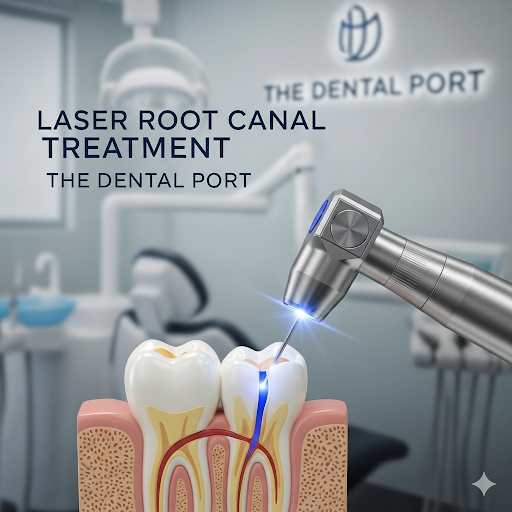
Dental lasers emit controlled light energy that targets the infected tissue. The water inside the damaged tissue absorbs the laser energy, causing the infected portions to break down and evaporate. At the same time, the laser disinfects the canal by eliminating bacteria that traditional methods may miss.
Procedure Steps
1st Appointment: Cleaning & Disinfection
-
The tooth is numbed for comfort.
-
The laser is used to remove infected tissue and sterilize the canal system.
-
A temporary filling is placed to protect the tooth.
2nd Appointment: Sealing & Restoration
-
The temporary filling is removed.
-
The canal is sealed permanently.
-
A crown or suitable restoration is placed to strengthen and protect the tooth.
Most patients can resume daily activities very soon after the procedure.
Laser-Assisted Root Canal vs. Conventional Root Canal
| Feature | Laser-Assisted RCT | Conventional RCT |
|---|---|---|
| Method | Laser removes infection and disinfects | Manual instruments and chemical irrigation |
| Precision | Higher precision, less damage to healthy tissue | Dependent on mechanical tools |
| Disinfection | Highly effective bacterial elimination | Good but may leave hard-to-reach areas |
| Comfort | Often less post-treatment discomfort | Slightly more sensitivity expected |
| Preservation | Conserves more of natural tooth | May require more removal of dentin |
Benefits of Laser-Assisted Root Canal Treatment
✔ More Precise & Thorough Cleaning
The laser reaches deep canal areas where traditional methods may struggle.
✔ Minimally Invasive
Less mechanical scraping means less trauma to the tooth.
✔ Reduced Pain & Sensitivity
The laser seals nerve endings as it works, often making the procedure more comfortable.
✔ Better Preservation of Tooth Structure
Only infected areas are targeted, helping to maintain the tooth’s strength.
✔ Faster Healing
Improved sterilization reduces post-treatment inflammation and promotes smoother recovery.
Laser Root Canal Treatment at The Dental Port, Noida Sector 168
At Advance Dental & Implant Center (The Dental Port), our dental team is trained in laser dentistry and minimally invasive root canal techniques. We use modern equipment to ensure comfortable, predictable, and long-lasting treatment outcomes. If you’re experiencing tooth pain, sensitivity, or swelling, early evaluation can save your tooth and prevent complications.
You can learn more or book an appointment through our website:
www.thedentalport.com
- Category: LaserAssisted Root Canal Treatment in Noida
- In stock: Yes


 Call Or Whatsapp Now